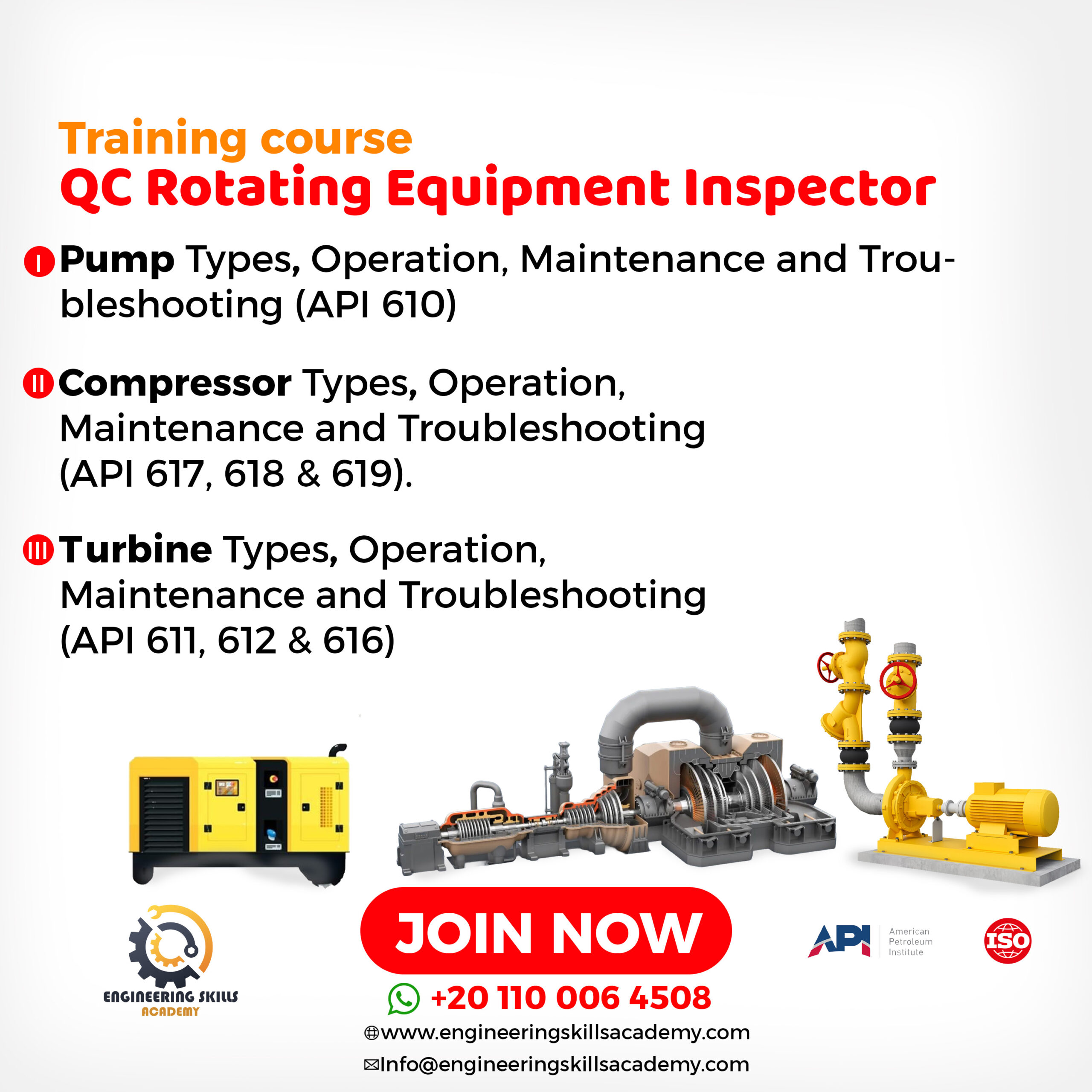
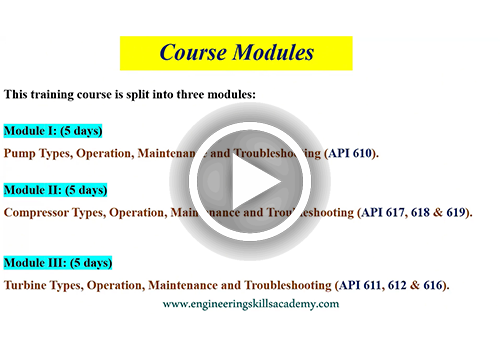
This training course is split into 4 modules:
Module I: Pump Types, Operation, Maintenance and Troubleshooting (API 610).
Module II: Compressor Types, Operation, Maintenance and Troubleshooting (API 617, 618 & 619).
Module III: Steam Turbine Types, Operation, Maintenance and Troubleshooting (API 611, 612).
Module IV : Gas Turbine Types, Operation, Maintenance and Troubleshooting (API 616).
Classification, Types of Pumps and Compressors
➢ Pump Types, Positive Displacement and Dynamic.
➢ Operating characteristics.
➢ Centrifugal Pumps.
➢ Priming, Cavitation.
➢ NPSHA, NPSHR.
➢ Power requirements for pumping.
➢ Pump curves and Pump Selection.
✓ Head capacity curve (H-Q).
✓ Efficiency capacity curve.
➢ Specific Speeds.
➢ Operating point of centrifugal pump.
➢ Pumping system optimization.
Operation and Troubleshooting
➢ Startup, Priming, Shut down.
➢ Vibration level and their measurements.
➢ Bearing housing temperatures.
➢ Accessories (Shaft seal, Bearing).
➢ API 610.
Troubleshooting (Symptoms, Causes and Remedial Measures)
➢ The function of bearing in rotating machine.
➢ Shaft alignment.
➢ How to correct Misalignment.
➢ Soft foot definition.
➢ Effects of soft foot.
➢ Measuring soft foot.
➢ Correcting soft foot.
Preventive and Predictive Maintenance
➢ Maintenance by plan Vs. Maintenance by default.
➢ Equipment reliability and availability.
➢ Building and maintenance management plan.
➢ Energy saving opportunities for pumps.
Compressors Working Principles, Types, Operational Aspects
➢ Classification, Types of compressors.
➢ Operational principles and constructional feathers.
➢ Compressor operation.
➢ Performance characteristics curve.
Compressors Operational Aspects, Selection and Specification Criteria
➢ Minimum and maximum flow constraints.
➢ Surge, significance and control.
➢ Compressor selection and specification criteria for drive rating selection.
➢ Performance testing.
➢ Standards and acceptance criteria for performance testing.
Operation, Troubleshooting and API Standards
➢ Startup, Priming, Shut down.
➢ Vibration level and their measurements.
➢ Bearing housing temperatures.
➢ Accessories (Shaft seal, Bearing).
➢ API 617 (Centrifugal Compressors).
➢ API 618 (Reciprocating Compressors).
➢ API 619 (Positive Displacement Compressors).
Troubleshooting (Symptoms, Causes and Remedial Measures)
➢ Surge and Stonewall on Compressors.
➢ Shaft alignment.
➢ How to correct Misalignment.
➢ Soft foot definition.
➢ Effects of soft foot.
➢ Measuring soft foot.
➢ Correcting soft foot.
Preventive and Predictive Maintenance
➢ Maintenance by plan Vs. Maintenance by default.
➢ Equipment reliability and availability.
➢ Building and maintenance management plan.
➢ Energy saving opportunities for Compressors.
➢ Steam Thermodynamic features.
➢ Steam Properties and the Mollier Charts.
➢ Principle of Action.
➢ Types of Turbine.
➢ Impulse Turbines.
➢ Reaction Turbines.
➢ Configuration Variants, Application Ranges & Constraints.
➢ Steam and Gas Turbines Components.
➢ Rotor Components.
➢ Reaction and Impulse Blading.
➢ Stator Blading.
➢ Steam and Gas Turbine Bearings.
➢ Sealing Systems.
➢ Governors and Control System.
➢ Main Elements and Technical Characteristics of Steam and Gas Turbines Design.
➢ Selection and Sizing of Steam and Gas Turbines for Compressor Drives.
➢ Steam (Water) Rates.
➢ Condensing and Backpressure Turbines.
➢ Single and Multistage Types.
➢ Process Considerations.
➢ Operations of Steam Turbines
✓ Commissioning.
✓ Startup.
✓ Run-In and Shut-down.
✓ Surveillance and Health Monitoring.
✓ Performance Measurement.
✓ Monitoring and Tracking.
✓ API 611 & 612.
➢ Operations of Gas Turbines
✓ Commissioning.
✓ Startup.
✓ Run-In and Shut-down.
✓ Surveillance and Health Monitoring.
✓ Performance Measurement.
✓ Monitoring and Tracking.
✓ API 616.
DAY 5:
➢ Machine Overhaul Process.
➢ Machines Piping and Ground Regulations.
➢ Alignment of Thermal Machines.
➢ Balancing of Rotating Machines.
➢ Surface Treatments of Sealing Interfaces.
➢ Online/Offline Washing.
➢ Troubleshooting through Vibration Analysis.
➢ Oil Analysis and Thermography.
Part 1: Fundamentals and API Standard 616 Overview
- Introduction to Gas Turbines
- Gas turbine history.
- Gas turbine types (heavy-duty vs. aeroderivative).
- Gas turbine Applications in oil & gas and power plants.
- Gas turbine main manufactures.
- Gas turbine advantages and disadvantages.
- Gas turbine Thermodynamics overview (Brayton Cycle)
- Gas turbine theory of operation.
- Performance parameters; heat rate, output power and efficiency.
- Gas Turbine Major Components
- Air Inlet section.
- Filter housing Assembly.
- Inlet duct assembly.
- Inlet casing Assembly.
- Inlet guide vanes.
- Compressor section.
- Axial flow compressor.
- Compressor surge.
- Combustion system.
- Combustion chamber arrangement.
- Primary, secondary and dilution air.
- DLN Combustion system.
- Turbine section.
- Turbine nozzles.
- Turbine rotor blades.
- Shafting and casing.
- API Standard 616 Overview
- Scope and structure of API Standard 616.
- Design and construction requirements.
- Materials and fabrication standards.
- Compliance and documentation.
- Codes & Standards Interface
- API, ISO, ASME relevance.
Part 2: Gas Turbines Systems and Operation
- Gas Turbine Auxiliary Systems
- Fuel systems (gas & liquid).
- Lubrication systems.
- Seal oil systems.
- Ventilation system.
- Cooling and air systems.
- Exhaust section.
- Exhaust section purpose.
- Exhaust section assembly.
- Gas Turbine Control and Protection Systems
- Control philosophy.
- Instrumentation and sensors.
- Fire and gas detection system.
- Trip and shutdown systems.
- Vibration and temperature monitoring.
- Online/Offline Washing
- Gas turbine water wash system.
- Gas Turbine Operation
- Start-up and shutdown procedures.
- Load control and performance optimization.
- Operating limits and safety precautions.
- Gas Turbine Frame Models
- Construction Criteria for Gas Turbines
- Gas Turbine bearings
- Hydrodynamic bearings
- Radial and thrust oil wedge
- Vibration Level and their Measurements
- Iso Standard 10816-4
Part 3: Maintenance and Condition Monitoring
- Maintenance Strategies
- Preventive vs predictive maintenance.
- Reliability-centered maintenance (RCM).
- Maintenance planning and scheduling.
- Inspection Techniques
- Borescope inspection.
- Combustion inspection.
- Hot gas path inspection
- Vibration analysis.
- Thermography.
- Oil analysis.
- Gas turbine clearances.
- Turbine bucket overview.
- Bucket replacement.
- Balance chart.
- Common Failure Modes
- Blade failure.
- Bearing failure.
- Combustion issues.
- Fouling and corrosion.
- Combined Turbines Systems
Part 4: Overhauling and Major Maintenance
- Overhaul Planning
- Scope definition.
- Spare parts and logistics.
- Risk assessment and safety planning.
- Disassembly and Inspection
- Rotor removal.
- Rotor axial movement.
- Component inspection criteria.
- NDT techniques.
- Repair and Reassembly
- Blade repair/replacement.
- Alignment and balancing.
- Torquing and clearances.
- Testing and Commissioning
- Post-overhaul checks.
- Performance testing.
- Documentation as per API Standard 616.
- Appropriate Tools and Equipment to Maintain Turbines and Auxiliary Systems
- Maintenance Requirements for Turbine Gearbox
- Shaft Alignment
- Soft Foot Definition.
- Effects of Soft Foot.
- Measuring Soft Foot.
- Correcting Soft Foot.
- How to Correct Gas Turbine’s Misalignment.
Part 5: Troubleshooting, Case Studies and Energy Saving Opportunities
- Troubleshooting Methodology
- Root Cause Analysis (RCA) approach.
- Fault identification techniques.
- Use of operating data.
- Common Operational Problems
- High vibration.
- Overheating.
- Loss of efficiency.
- Startup failures.
- Evaluating and Interpreting Performance and Integrity Data of Turbines
- Recognizing and Responding to Abnormal Conditions and take Appropriate Corrective Action
- Maintenance by Plan Vs. Maintenance by Default.
- Gas Turbine Reliability and Availability.
- Building and Maintenance Management Plan.
- Energy Saving Opportunities for Gas Turbines.
- Case Studies and Practical Scenarios
- Real-life failure analysis.
- Lessons learned from industry incidents.
- Course Wrap-Up
- Best practices summary.
- Open discussion and Q&A.
- Knowledge assessment.
هل الدورة اونلاين ؟
نعم ، الدبلومة اونلاين عبر zoom meeting من خلال الشرح الاونلاين التفاعلي وايضا تحصل علي التسجيلات ويمكنك الاحتفاظ بها .
هل يمكنني الحصول علي مديول واحد فقط ؟
نعم ، يمكنك الحصول علي مديول واحد فقط لأن الدبلومة مقسمة الي اربعة مديولات كل مديول بمثابة كورس منفصل بشهادة منفصلة .
هل احصل علي شهادة بعد اتمام دراسة الدبلومة ؟
نعم ، يمكنك الحصول علي شهادة لكل مديول ، الشهادة معتمدة من الاكاديمية وموثقة علي موقع الاكاديمية .
هل هذا الكورس مؤهل لشهادة دولية ؟
الدبلومة يتم فيها تناول الجانب المعرفي والعملي كما هو مذكور في محتوي الدبلومة ، ايضا الدبلومة تساعدك علي فهم الاكواد العاليمة (API) المؤهلة لأمتحان API SIER الدولي.
هل يمكنني الحصول علي الماتريل وتسجيلات المحاضرات ؟
نعم ، يمكنك الحصول علي تسجيلات المحاضرات واحدث نسخة مشفرة من الاكواد المستخدمة وكذلك المادة العلمية.
هل الدورة مناسبة لحديثي التخرج ايضا ؟
نعم ، الدبلومة مناسبة جدا لحديث التخرج وايضا الرغبين في الدخول الي هذا المجال ، لانها تبدأ معاك من الصفر وحتي الاحتراف ، وذلك لانك ينقل لك خلاصة الخبرة العلمية والعملية من خلال المدرب والمادة العلمية .