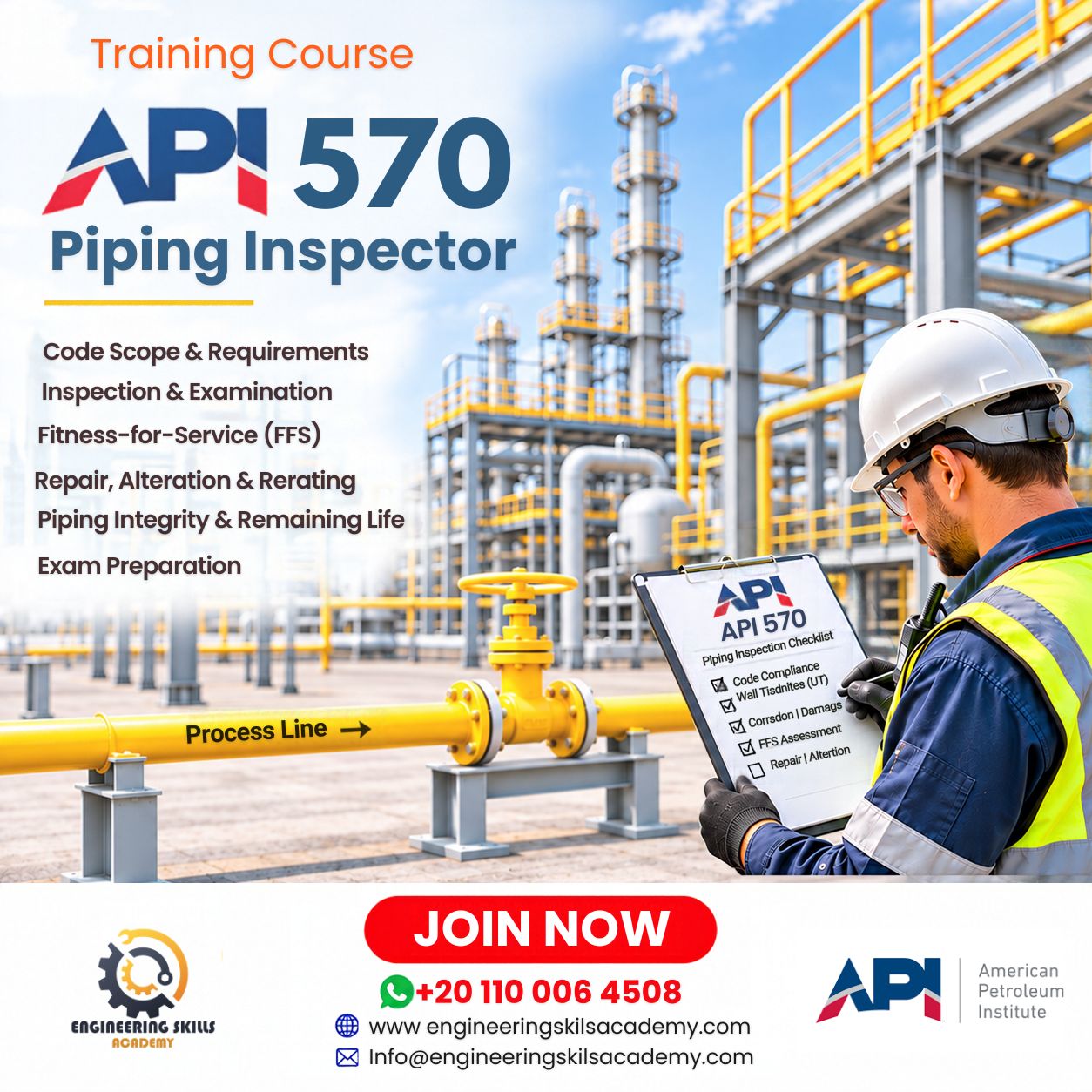
API 570 Exam Preparation
كورس API 570 | تأهيل مفتش المواسير المعتمد
يُعد كود API 570 – Piping Inspection Code من أهم الأكواد الهندسية المتخصصة في مجال فحص وتفتيش أنظمة المواسير (Piping Systems) أثناء التشغيل، ويُستخدم على نطاق واسع في شركات البترول والغاز ومصافي التكرير والصناعات البتروكيماوية.
يهدف البرنامج التأهيلي إلى إعداد المهندسين والمتخصصين لاجتياز اختبار شهادة API 570 Certified Piping Inspector، من خلال دراسة متطلبات الكود والمراجع الهندسية المساندة الصادرة عن API وASME، والتعرف على متطلبات التفتيش والتقييم والإصلاح والتعديل لأنظمة المواسير.
يشمل البرنامج دراسة آليات التآكل والتلف (Damage Mechanisms)، وطرق الفحص والاختبارات غير الإتلافية (NDT)، ومتطلبات اللحام وتأهيل إجراءاته، بالإضافة إلى متطلبات الإصلاحات الهندسية وحسابات سمك المواسير ومعدلات التآكل والعمر المتبقي.
كما يركز البرنامج على دراسة المراجع المطلوبة لامتحان API 570 وفقًا للـ Body of Knowledge – February 2027، مع تحديد الأجزاء والفصول والجداول المطلوبة من كل كود ومرجع، بما يساعد المتدربين على تنظيم دراستهم والاستعداد بشكل فعال للامتحان.
يستهدف البرنامج المهندسين العاملين في مجالات Mechanical Engineering وPiping وInspection وQA/QC وCorrosion وMaintenance، وكذلك المتخصصين الراغبين في تطوير خبراتهم الفنية والحصول على شهادة API 570 الدولية.
API 570 Exam Preparation Course
About the course
Course Overview
This course is designed to prepare candidates for the API 570 Piping Inspector Certification Examination. Its scope follows the API 570 Body of Knowledge (February 2027) supplied for course development and is organized by reference code and standard. Coverage is limited to the documents, sections, clauses, articles, tables and topics identified in that Body of Knowledge.
Course Reference Publications
API 570 – Piping Inspection Code: In-service Inspection, Rating, Repair, and Alteration of Piping Systems
API RP 571 – Damage Mechanisms Affecting Fixed Equipment in the Refining Industry
API RP 574 – Inspection Practices for Piping System Components
API RP 576 – Inspection of Pressure-Relieving Devices
API RP 577 – Welding Processes, Inspection, and Metallurgy
API RP 578 – Material Verification Program for New and Existing Assets
ASME BPVC Section V – Nondestructive Examination
ASME BPVC Section IX – Qualification Standard for Welding, Brazing, and Fusing Procedures; Welders; Brazers; and Welding, Brazing, and Fusing Operators
ASME B16.5 – Pipe Flanges and Flanged Fittings: NPS ½ Through NPS 24 Metric/Inch Standard
ASME B31.3 – Process Piping
ASME PCC-2 – Repair of Pressure Equipment and Piping
Detailed Syllabus – Organized by Code and Standard
1. API 570 – Piping Inspection Code
Coverage: Entire document.
2. ASME B31.3 – Process Piping
2.1 Casting and Weld Joint Quality Factors
302.3.3(b) – Casting Quality Factor (Ec).
Table A-1A – Casting Quality Factors.
302.3.4 – Weld Joint Quality Factor (Ej).
Table A-1B – Weld Joint Quality Factors.
Table 302.3.4 – Increased Joint Quality Factors through Supplemental NDE.
2.2 Internal Pressure and Minimum Thickness
304.1.1 – Straight Pipe Under Internal Pressure.
304.1.2 – Straight Pipe Under Internal Pressure.
304.5.3 – Pressure Design of Permanent Blanks.
2.3 Welding Requirements – Chapter V
Typical weld joints and definitions.
Weld sizes.
Restrictions on joints.
Maximum allowable weld reinforcement.
Inspection requirements.
2.4 Preheating and Heat Treatment – Chapter VI
Preheating requirements.
Postweld heat treatment requirements.
Table 330.1.1 – Preheating and Heat Treatment Requirements.
2.5 Nondestructive Examination – Chapter VI
General NDE requirements.
Examination methods.
Examination extent and requirements.
2.6 Pressure Testing
345.4 – Hydrostatic Leak Testing.
345.5 – Pneumatic Leak Testing.
2.7 Impact Testing
323.2.2 – Impact Testing Requirements and Exemptions.
Figure 323.2.2A – Impact Testing Exemption Curve.
Table A-1 – Material Information.
323.3 – Impact Testing Requirements.
Table 323.3.5 – Minimum Charpy V-Notch Impact Values.
2.8 Thermal Expansion
Appendix C – Thermal Expansion.
Table C-1 – Coefficients of Thermal Expansion.
3. ASME BPVC Section IX – Welding, Brazing and Fusing Qualifications
Coverage: Welding qualification requirements only. Brazing is excluded.
3.1 Welding Procedure Specification (WPS)
WPS requirements.
Essential variables.
Non-essential variables.
Applicable welding processes.
Base metal qualification.
Filler metal qualification.
Welding thickness qualification.
Welding position qualification.
3.2 Procedure Qualification Record (PQR)
PQR requirements.
Recording actual welding variables.
Essential variables.
Mechanical testing requirements.
Tensile testing.
Guided bend testing.
Evaluation of test results.
PQR supporting WPS.
3.3 Welder Performance Qualification (WPQ)
Welder qualification requirements.
Essential variables.
Position qualification.
Thickness qualification.
Diameter qualification.
Welder continuity.
3.4 Welding Processes Covered
SMAW.
GTAW.
GMAW.
SAW.
3.5 Base Metal and Filler Metal Limitations
P-No. 1.
P-No. 3.
P-No. 4.
P-No. 5.
P-No. 8.
Filler metals: one per process.
3.6 Practical Qualification Review
WPS/PQR compliance.
Essential and non-essential variable verification.
Mechanical test evaluation.
Welder qualification verification.
Production weld qualification.
4. ASME BPVC Section V – Nondestructive Examination
4.1 Article 1 – General Requirements
Scope.
Rules for using Section V as a referenced Code.
Owner/user and subcontractor responsibilities.
Calibration.
Inspection and examination definitions.
Record keeping requirements.
4.2 Article 2 – Radiographic Examination (RT)
Scope and general requirements.
Required marking.
IQI selection and placement.
IQI type and number.
Radiographic density.
Density ranges.
Backscatter radiation control.
Records.
4.3 Article 6 – Liquid Penetrant Examination (PT)
Scope.
Procedures.
Contaminants.
Examination techniques.
Examination.
Interpretation.
Documentation and record keeping.
Mandatory Appendix II.
Mandatory Appendix III.
4.4 Article 7 – Magnetic Particle Examination (MT)
Scope.
Procedures.
Yoke technique.
Prod technique.
Calibration.
Examination.
Interpretation.
Documentation and record keeping.
4.5 Article 9 – Visual Examination (VT)
Scope.
Procedures.
Physical requirements.
Procedure and technique.
Evaluation.
Documentation and record keeping.
4.6 Article 10 – Leak Testing (LT)
Scope.
Procedures.
Equipment.
Calibration.
Testing.
Evaluation.
Documentation and record keeping.
Mandatory Appendix I – Bubble Test, Direct Pressure Technique.
4.7 Article 23 – Ultrasonic Thickness Measurement
SE-797 – Standard Practice for Measuring Thickness by Manual Ultrasonic Pulse-Echo Contact Method.
Scope.
General requirements.
Thickness measurement procedures – Paragraph 7.
5. API RP 571 – Damage Mechanisms Affecting Fixed Equipment in the Refining
Industry
Coverage: Section 2 – Definitions and specified damage mechanisms only.
API 571 Reference Damage Mechanism / Subject
Section 2 Definitions
3.3 Amine Stress Corrosion Cracking
3.8 Atmospheric Corrosion
3.9 Boiler Water and Steam Condensate Corrosion
3.14 Caustic Corrosion
3.15 Caustic Stress Corrosion Cracking
3.17 Chloride Stress Corrosion Cracking
3.22 Corrosion Under Insulation (CUI)
3.27 Erosion/Erosion-Corrosion
3.31 Galvanic Corrosion
3.37 Hydrochloric Acid Corrosion
3.43 Mechanical Fatigue (including vibration-induced fatigue)
3.45 Microbiologically Influenced Corrosion (MIC)
3.57 Soil Corrosion
3.58 Sour Water Corrosion (Acidic)
3.61 Sulfidation
6. API RP 574 – Inspection Practices for Piping System Components
Coverage: Entire document.
Inspection practices for piping system components.
Inspection planning.
Piping components and inspection requirements.
Inspection locations.
Thickness measurement locations.
External inspection.
Internal inspection.
Inspection of pipe fittings.
Inspection of valves.
Inspection of flanges.
Inspection of piping connections.
Inspection of small-bore piping.
Inspection of dead legs.
Inspection of injection points.
Inspection of pipe supports.
Inspection of insulated piping.
Inspection of buried piping.
Inspection records and reports.
7. API RP 576 – Inspection of Pressure-Relieving Devices
Coverage: Specified sections only.
7.1 Section 5
Inspection of pressure-relieving devices.
7.2 Sections 6.1–6.5
Inspection and testing requirements.
Examination and evaluation.
Applicable testing practices.
7.3 Section 7
Repair of pressure-relieving devices.
8. API RP 577 – Welding Processes, Inspection and Metallurgy
Coverage: Entire document.
9. API RP 578 – Material Verification Program for New and Existing Assets
Coverage: Entire document.
10. ASME B16.5 – Pipe Flanges and Flanged Fittings
10.1 Scope
Scope and application.
10.2 Pressure-Temperature Ratings
Pressure-temperature ratings.
Working pressure.
Maximum allowable pressure.
Maximum allowable temperature.
Hydrostatic test pressure.
10.3 Markings
Flange marking requirements.
10.4 Materials
Flange material requirements.
10.5 Dimensions
Flange dimensions.
Tables 7 through 22.
Tables 7C through 22C.
10.6 Testing
Testing requirements.
10.7 Limiting Dimensions of Gaskets
Gasket dimensional requirements.
10.8 Methods for Establishing Pressure-Temperature Ratings
Pressure-temperature rating methodology.
11. ASME PCC-2 – Repair of Pressure Equipment and Piping
Coverage: Specified Articles and their Appendices. Article Subject
Article Subject
101 Introduction
201 Butt-Welded Insert Plates in Pressure Components
206 Full Encirclement Steel Reinforcing Sleeves for Piping
209 Alternatives to Postweld Heat Treatment
210 In-Service Welding on Carbon Steel Pressure Components or Pipelines
211 Weld Buildup, Weld Overlay and Clad Restoration
212 Fillet Welded Patches
304 Flaw Excavation and Weld Repair
305 Flange Repair and Conversion
306 Mechanical Clamp Repair
501 Pressure and Tightness of Piping and Equipment
502 Nondestructive Examination in Lieu of Pressure Testing for Repairs and Alterations

الأسئلة الشائعة
هل الدورة اونلاين ؟
نعم ، الدورة اونلاين عبر
zoom meeting
من خلال الشرح الاونلاين التفاعلي وايضا تحصل علي التسجيلات ويمكنك الاحتفاظ بها .
مدة الدورة ؟
الدورة اونلاين عبر
zoom meeting
مدة الكورس 15 يوم متتالية مدة المحاضرة 3 ساعات يوميا .
هل احصل علي شهادة بعد اتمام دراسة الكورس ؟
نعم ، يمكنك الحصول علي شهادة بعد اتمام دراسة الكورس ، الشهادة معتمدة من الاكاديمية وموثقة علي موقع الاكاديمية .
هل هذا الكورس مؤهل لشهادة دولية ؟
الكورس يتم فيها تناول الجانب المعرفي والعملي كما هو مذكور في محتوي الكورس ، ايضا الكورس يساعدك علي فهم الاكواد العاليمة التي تؤهلك لاجتياز للأمتحان الدولي API570 .
هل يمكنني الحصول علي الماتريل وتسجيلات المحاضرات ؟
نعم ، يمكنك الحصول علي تسجيلات المحاضرات واحدث نسخة من الاكواد المستخدمة وكذلك المادة العلمية.
هل الدورة مناسبة لحديثي التخرج ايضا ؟
لا، يجب ان يكون لديك خبرة علي الاقل سنتين في هذا المجال حتي تتمكن من اجتيار الامتحان الدولي اذا كنت ترغب في ذلك ، اما اذا كنت تريد فقط دخول الكورس للمعرفة وتعزيز الخبرة فهو مناسب لحديث التخرج .