API RP 571 Corrosion & Damage Mechanisms
Exam Preparation
كورس API 571 – Corrosion & Damage Mechanisms هو كورس احترافي مصمم لتأهيل المهندسين لفهم وتحليل جميع آليات التآكل والتلف (Damage Mechanisms) التي تحدث في معدات وأنظمة النفط والغاز، بالإضافة إلى التحضير الكامل لاجتياز امتحان API 571.
يركز الكورس على الربط بين الفهم النظري + التطبيق العملي + متطلبات الامتحان، بحيث يكون المتدرب قادرًا على اتخاذ قرارات صحيحة في الشغل الحقيقي، وليس فقط اجتياز الامتحان.
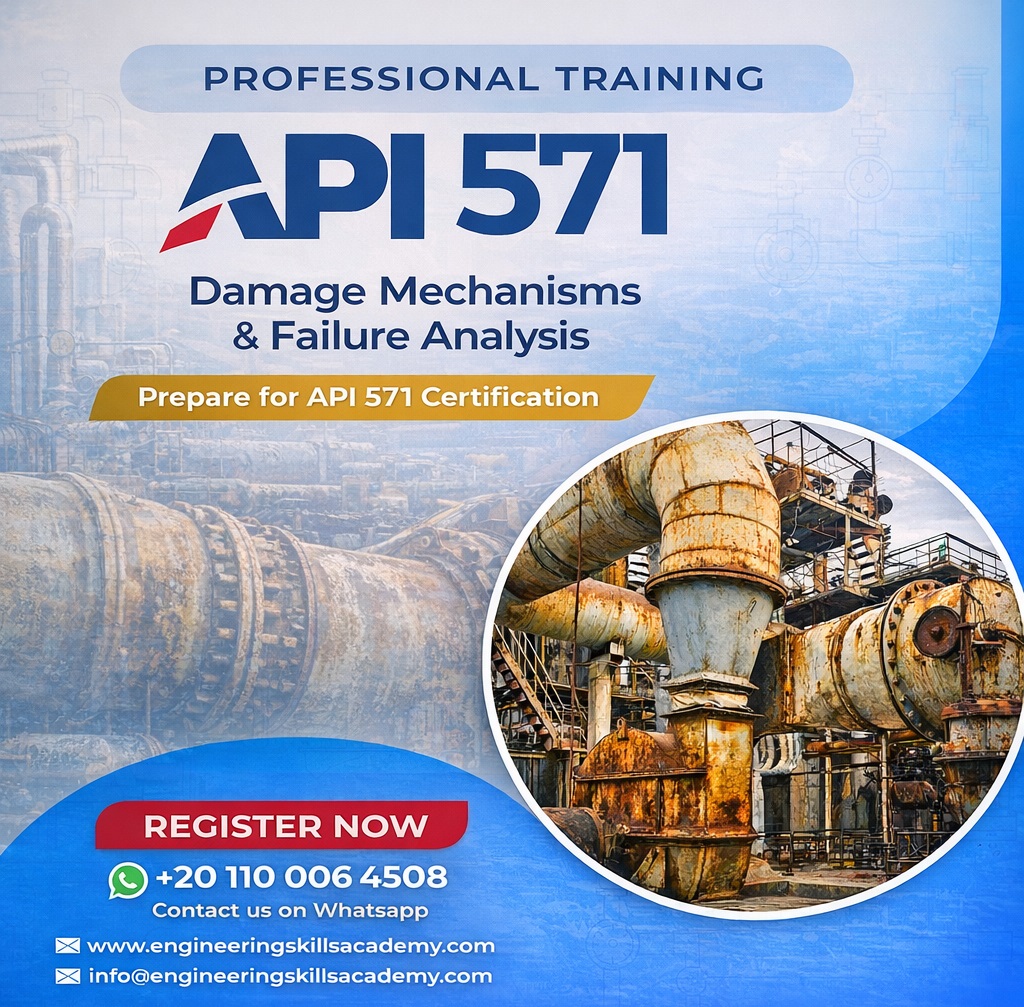
API RP 571 Exam Preparation Course
Course Objectives
The API RP 571 (3rd Edition – 2020) provides comprehensive guidance on damage mechanisms affecting equipment in refining and petrochemical industries.
Understanding these mechanisms is a critical step in ensuring equipment integrity, safety, and reliability. It also plays a key role in the proper implementation of inspection codes such as API 510, API 570, and API 653, as well as Risk-Based Inspection (RBI) per API 580 and API 581.
In addition, accurate identification of damage mechanisms is essential when performing Fitness-For-Service (FFS) assessments according to API 579.
This course provides a structured and practical approach to understanding all damage mechanisms listed in API 571, along with their causes, effects, inspection methods, and prevention techniques, with a strong focus on exam preparation.
Who Should Attend
- Mechanical Engineers
- Process Engineers
- Inspection Engineers
- Maintenance Engineers
- Plant Inspectors
- Designers working in Oil & Gas and Petrochemical industries
Course Outlines
Day 1: Fundamentals & Introduction
1. Corrosion Fundamentals
- Definition and real-world examples
- Why metals corrode
- Forms of corrosion
- General corrosion control methods
- Common alloys in refining & petrochemical industries
2. API 571 Overview
- Introduction to API RP 571 (2020 Edition)
- What’s new in the latest edition
- Comparison: 2011 vs 2020 edition
- Terms and definitions
3. Damage Mechanisms (Part 1)
- 885°F (475°C) Embrittlement
- Amine Corrosion
- Amine Stress Corrosion Cracking
Day 2: Damage Mechanisms (Part 2)
- Ammonia Stress Corrosion Cracking
- Ammonium Bisulfide Corrosion
- Ammonium Chloride / Amine Hydrochloride Corrosion
- Aqueous Organic Acid Corrosion
- Atmospheric Corrosion
- Boiler Water & Steam Condensate Corrosion
- Brine Corrosion
- Brittle Fracture
Day 3: Damage Mechanisms (Part 3)
- Carbonate Stress Corrosion Cracking
- Carburization
- Caustic Corrosion
- Caustic Stress Corrosion Cracking
- Cavitation
- Chloride Stress Corrosion Cracking
Day 4: Damage Mechanisms (Part 4)
- CO₂ Corrosion
- Concentration Cell Corrosion
- Cooling Water Corrosion
- Corrosion Fatigue
- Corrosion Under Insulation (CUI)
- Creep & Stress Rupture
Day 5: Damage Mechanisms (Part 5)
- Dealloying
- Decarburization
- Dissimilar Metal Weld Cracking
- Erosion / Erosion-Corrosion
- Ethanol Stress Corrosion Cracking
- Flue Gas Dew Point Corrosion
- Fuel Ash Corrosion
- Galvanic Corrosion
Day 6: Damage Mechanisms (Part 6)
- Oxygen-enhanced Ignition & Combustion
- Graphitic Corrosion of Cast Iron
- Graphitization
- High-temperature H₂ / H₂S Corrosion
- High-temperature Hydrogen Attack (HTHA)
- Hydrochloric Acid Corrosion
Day 7: Damage Mechanisms (Part 7)
- Hydrofluoric Acid Corrosion
- HF Acid SCC in Nickel Alloys
- Hydrogen Embrittlement
- Hydrogen Stress Cracking
- Liquid Metal Embrittlement
- Mechanical Fatigue
Day 8: Damage Mechanisms (Part 8)
- Metal Dusting
- Microbiologically Influenced Corrosion (MIC)
- Naphthenic Acid Corrosion
- Nitriding
- Oxidation
- Oxygenated Water Corrosion
Day 9: Damage Mechanisms (Part 9)
- Phenol Corrosion
- Phosphoric Acid Corrosion
- Polythionic Acid SCC
- Refractory Degradation
- Stress Relaxation Cracking
- Short-term Overheating
- Sigma Phase Embrittlement
- Soil Corrosion
Day 10: Damage Mechanisms (Part 10)
- Sour Water Corrosion
- Spheroidization
- Strain Aging
- Sulfidation
- Sulfuric Acid Corrosion
- Temper Embrittlement
- Thermal Fatigue
- Thermal Shock
- Titanium Hydriding
- Wet H₂S Damage (HIC / SSC / SOHIC / Blistering)
Exam Preparation
- Full Mock Exam Practice
- Solved Questions & Explanations
- Key Exam Tips & Strategies
- Focus on frequently asked questions
Course Outcome
By the end of this course, participants will be able to:
- Identify and analyze all damage mechanisms in API 571
- Apply inspection techniques effectively
- Support RBI and FFS assessments
- Make accurate engineering decisions
- Pass the API 571 Exam with confidence
الأسئلة الشائعة
هل الدورة اونلاين ؟
نعم ، الدورة اونلاين عبر
zoom meeting
من خلال الشرح الاونلاين التفاعلي وايضا تحصل علي التسجيلات ويمكنك الاحتفاظ بها .
مدة الدورة ؟
الدورة اونلاين عبر
zoom meeting
مدة الكورس 10 يوم متتالية مدة المحاضرة 3 ساعات يوميا .
هل احصل علي شهادة بعد اتمام دراسة الكورس ؟
نعم ، يمكنك الحصول علي شهادة بعد اتمام دراسة الكورس ، الشهادة معتمدة من الاكاديمية وموثقة علي موقع الاكاديمية .
هل هذا الكورس مؤهل لشهادة دولية ؟
الكورس يتم فيها تناول الجانب المعرفي والعملي كما هو مذكور في محتوي الكورس ، ايضا الكورس يساعدك علي فهم الاكواد العاليمة التي تؤهلك لاجتياز للأمتحان الدولي API571 .
هل يمكنني الحصول علي الماتريل وتسجيلات المحاضرات ؟
نعم ، يمكنك الحصول علي تسجيلات المحاضرات واحدث نسخة من الاكواد المستخدمة وكذلك المادة العلمية.
هل الدورة مناسبة لحديثي التخرج ايضا ؟
لا، يجب ان يكون لديك خبرة علي الاقل سنتين في هذا المجال حتي تتمكن من اجتيار الامتحان الدولي اذا كنت ترغب في ذلك ، اما اذا كنت تريد فقط دخول الكورس للمعرفة وتعزيز الخبرة فهو مناسب لحديث التخرج .